Governments around the world have used the label “terrorist” to define a specific group of enemies in the public consciousness and justify its actions to fight them. A look back at the term’s origins shows how it has evolved over time – to a point where it is now largely meaningless yet remains a useful cover for serious human rights violations committed by states.
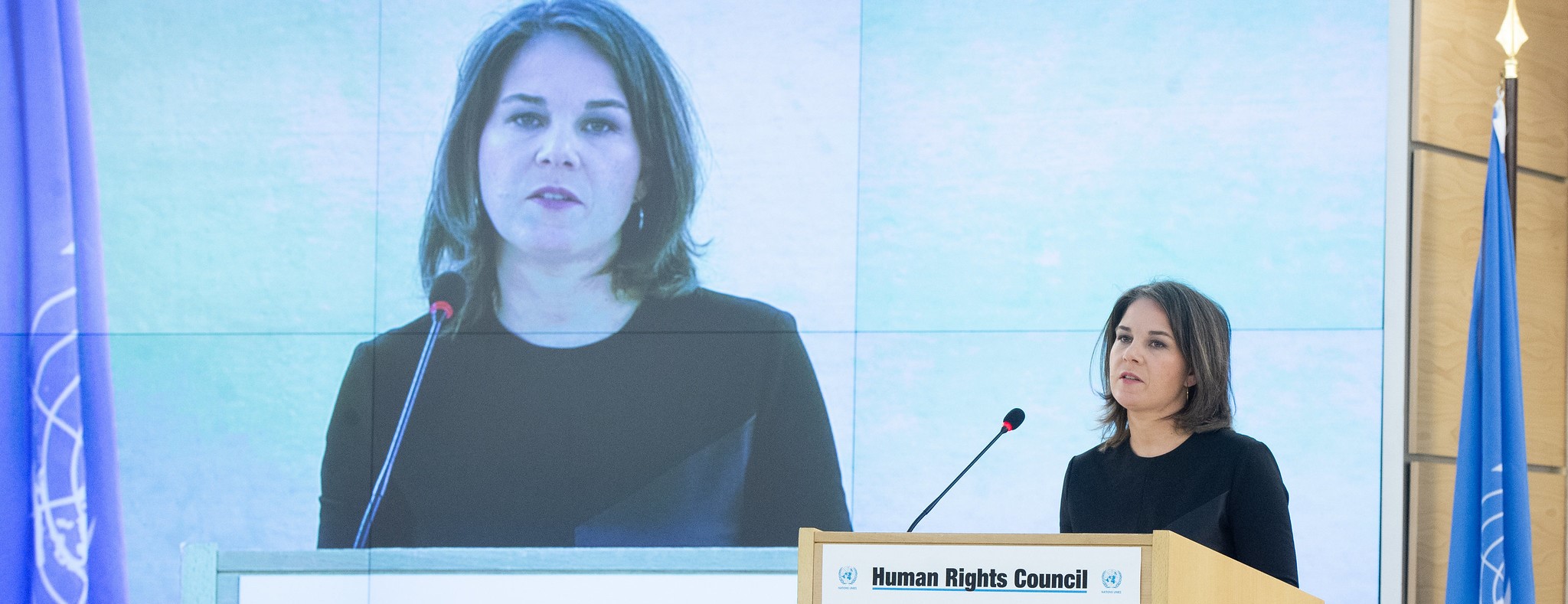
Addressing the Bundestag in October, German Foreign Minister Annalena Baerbock doubled down on her country’s support for the actions of Israel’s military in Gaza. “Self-defence means not just attacking terrorists but destroying them,” she declared, adding that civilian places were liable to “lose their protected status” when “terrorists exploit them”. This “gets us into difficult territory” said Baerbock, in a euphemistic reference to what her government regards as the unsavoury obligation of killing and maiming civilians in large numbers, and destroying the vital infrastructures on which they depend, to safeguard Israel’s security.
The foreign minister’s rhetoric recalls that of George W. Bush and his administration in the aftermath of the September 11th attacks. The deliberately vague and undefined concept of a “war on terror” deployed then has been described as part of a “reality-shaping strategy” establishing a framework to underpin the response and a justification for its consequences.
The idea of “fighting terror” divorces acts of terror from their context – it refuses any engagement with underlying grievances or injustices, and any contemplation of root causes or dynamics. It establishes the symptoms themselves (acts of “terror” carried out by “terrorists”) as the enemy to be vanquished. Now, as then, the pursuit of “victory against terrorism” leaves no space for acknowledgements of complexity or nuance. In this sense, it is a rhetoric that denies reality, be it in Gaza, Iraq, or elsewhere, and as a result is inevitably unachievable.
The objective of “destroying terrorists” that Baerbock commits to seems particularly self-defeating given the reality that violence fosters resistance and counter-violence – particularly violence that is patently unjust – such as that which targets civilians. In its absolutism it is straight out of the Bush playbook by its suggestion that “terrorism” is a meaningful entity and its implicit assumption that there is a clear demarcation between those who are “terrorists” and those who aren’t (as he put it, “you are either with us or against us”). Despite this distinction however, “attacking terrorists” also sometimes requires attacking others, according to the principles espoused by Bush and Baerbock. Israel’s claim that humanitarian organisations in Gaza, such as UNRWA, are inextricably linked to Hamas have been used to justify attacks on aid workers and infrastructure.
Such conflation recalls the tactics of authoritarian political leaders such as Turkish President Recep Tayyip Erdoğan’s targeting of journalists, civil society activists, and political opponents. Many have been jailed on terror-related charges, on the basis of even the most tenuous of connections to the political movement or ethnic identity associated with the Kurdish armed struggle against the Turkish state.
How states went from victims to perpetrators
The label “terrorist” provides states with a convenient shorthand for establishing and referring to a specific group of enemies in the public imagination. And the threat of “terror” has long been deployed as a justification for cracking down on democratic rights and civil liberties more broadly. Think of the post 9/11 surveillance measures that were brought in virtually overnight across the world, or the way countries such as France, Germany, and Hungary have used state of emergency rules to enact restrictions on freedom of movement.
This was not always the case. As Matt Seaton points out, earlier usage (that can be traced back to the French Revolution) defined terror as violence by the state – such as the “Stalinist terror” of the 1930s, and in many other contexts. Seaton situates the turning point in the period of decolonisation after World War II, and the imprisonment of anti-apartheid activists in the 1960s:
“This reversal of semantic polarities […] could only have taken place through the West’s experience of various postcolonial ‘emergencies.’ The essential terrorist, as [Edward] Said noted, must be an enemy other who will carry the burden of this new meaning. This has manifested in so-called emergencies all over the world, from Malaya to Kenya to Algeria to Vietnam to Northern Ireland.”
It is a moment when “we see the meanings of terror and terrorism shift from violence inflicted by the state upon its citizenry to violence committed against the state by certain of its citizens.” In this way, terror becomes a crime against, rather than of, the state. And of course, its right to “self-defence” is absolute and unlimited.
“We see the meanings of terror and terrorism shift from violence inflicted by the state upon its citizenry to violence committed against the state by certain of its citizens.”
Matt Seaton
Short on meaning, long on consequences
South Africa adopted anti-terrorism legislation in the 1960s, and many other countries followed suit. After 9/11, the concept became much more diffuse and took on a global scale, providing certain states with the right not just to target the enemies within but those identified anywhere in the world. The term’s malleability is enhanced further by the absence of a universal definition of terrorism.
This created the conditions for national armies to ignore their human rights obligations, disregarding conventions to prevent the use of torture for instance, while still retaining the moral high ground.
“Although designed to combat terrorism, the USA Patriot Act and the Authorization for Use of Military Force have themselves become instruments of terror,” writes Seaton.
Unchallenged, the “fighting terror” narrative leaves intact, and even reinforces, the state’s power to define its enemies and attack them (and those adjacent to them) through any and all means in the name of public security. The targets themselves may shift, based on who is in power, but the rhetorical strategy is the same. As is the result: human rights can be overridden; indeed massacres of civilians are justified.
Such is the flagrance of this hypocrisy, and the hollowing out of any meaning, Seaton is right to ask whether “terror” has reached “the end of the semantic road” and argue that it is time to “banish the tainted term from the lexicon of public discourse.” Given the term’s entrenchment in the discourse, this seems a tall order.
At the very least, however, it should not be unthinkingly repeated by journalists, commentators, or as in the case of Baerbock – deployed by supposedly progressive politicians who claim to support universal human rights.
Image by UN Geneva (UN Photo / Violaine Martin) via Flickr, Creative Commons License CC BY-NC-ND 2.0
Leave a Reply